Executive Summary
At HudsonLogic, we believe that the foundation of data-driven success begins with business-aligned analytics platforms. This guide distills years of experience in enterprise data transformation into a practical framework for evaluating and selecting modern Analytics and Business Intelligence (BI) platforms. Whether your goal is agility, self-service, or AI readiness, this whitepaper is designed to help you navigate the evolving analytics landscape with clarity and confidence.
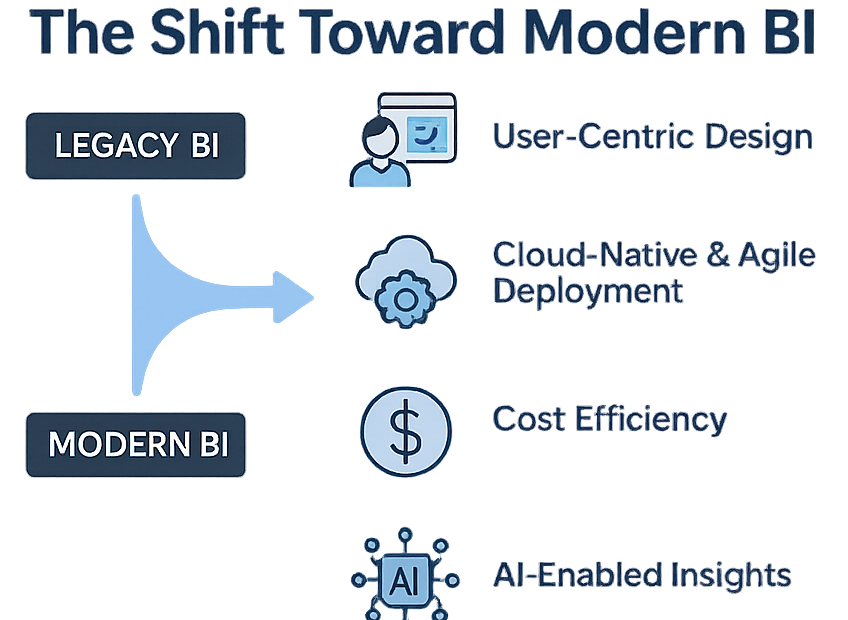
The Shift Toward Modern Analytics
The analytics landscape has undergone significant change, with organizations demanding:
- User-Centric Design: Platforms must be intuitive for business users, not just data professionals.
- Cloud-Native and Agile Deployment: Time-to-value and elastic scalability are now essential.
- Cost Efficiency: Subscription models and operational cost transparency are critical.
- AI-Enabled Insights: Platforms must support augmented analytics, machine learning, and automation capabilities.
At HudsonLogic, we help clients transition from legacy BI to modern analytics stacks that support real-time insight delivery, data governance, and readiness for AI-driven innovation.
HudsonLogic’s Proven Evaluation Framework
- Assemble a Cross-Functional Team
Involve both business and technical leaders to ensure organizational alignment. - Define Usage Scenarios
Clarify who will use the platform and for what purpose—executive dashboards, operational reports, data discovery, etc. - Prioritize Requirements
Use our Data Readiness Scoring Model to rank functional, technical, and strategic needs. - Run Scripted Demos
Replace vendor-led canned demos with your real use cases—using your data, priorities, and KPIs. - Host an Analytics Bake-Off
Compare vendors side-by-side using weighted criteria and sample business scenarios. - Execute a Proof of Concept (PoC)
Validate platform capabilities in your real-world environment.
Sample Evaluation Scorecard
| Evaluation Criteria | Weight | Vendor A | Vendor B | Vendor C |
|---|---|---|---|---|
| Ease of Use | 3 | Excellent | Good | Limited |
| Governance and Security | 2 | Good | Limited | Good |
| Data Source Flexibility | 3 | Excellent | Good | Excellent |
| Report Scheduling | 1 | Minimal | Excellent | Good |
| Multi-Source Integration | 2 | Good | Good | Good |
| HudsonLogic Fit Score | 96% | 65% | 73% |
Platform Comparison: Leading BI & Analytics Tools
| Capability | Microsoft Power BI | Qlik Sense | Tableau | ThoughtSpot | Incorta |
|---|---|---|---|---|---|
| Data Source Connectivity | ★★★★★ | ★★★ | ★★★★ | ★★★★ | ★★★★★ |
| Complex Model Support | ★★★ | ★★★★ | ★★★ | ★★★★ | ★★★★★ |
| Augmented Analytics | ★★ | ★★★ | ★ | ★★★ | ★★★ |
| Visual Exploration | ★★★★ | ★★★★ | ★★★★★ | ★★ | ★★★ |
| Collaboration & Sharing | ★★ | ★★★ | ★★★ | ★★★★ | ★★★★ |
| Ease of Use & Workflow | ★★★★ | ★★★★ | ★★★★★ | ★★★★★ | ★★★★ |
| Governance & Security | ★★★ | ★★★ | ★★★ | ★★ | ★★★★ |
| Pricing Model | Low, Subscription | Mixed | High | Subscription | Subscription |
| HudsonLogic Alignment | Moderate | Moderate | High | Niche | Excellent |
Why Incorta?
- Direct Data Mapping with no traditional ETL needed—ideal for ERP-heavy organizations.
- Fast Time-to-Insight using prebuilt business schemas and incremental data loads.
- Cloud-native or On-premise, enabling hybrid strategies.
- Built-in support for operational analytics, ideal for finance, supply chain, and manufacturing.
HudsonLogic supports clients with Incorta POCs, performance tuning, schema design, and executive dashboard enablement.
Scripted Demos: HudsonLogic’s Best Practices
A scripted demo replicates the actual user experience. For maximum impact:
- Use your organization’s data and business questions.
- Design dashboards that showcase variance analysis, trend insights, and KPI alerts.
- Assess AI features like natural language querying or automated insights.
- Review governance capabilities, especially row-level security and data lineage transparency.
Strategic Guidance from HudsonLogic
- Start small, scale smart: Run pilot projects with high-value use cases.
- Focus on outcomes, not features: Evaluate based on business impact.
- Ensure governance is baked in: Don’t sacrifice control for speed.
- Prioritize platforms that accelerate AI readiness: Choose tools that align with your long-term automation roadmap.